
Press Release
BUYING SANDLOT: Curve Sports Is Testing Its Tests
Athletic and performance testing data and metrics have become critical for all stakeholders in youth sports — athletes, parents, trainers, coaches, recruiters.

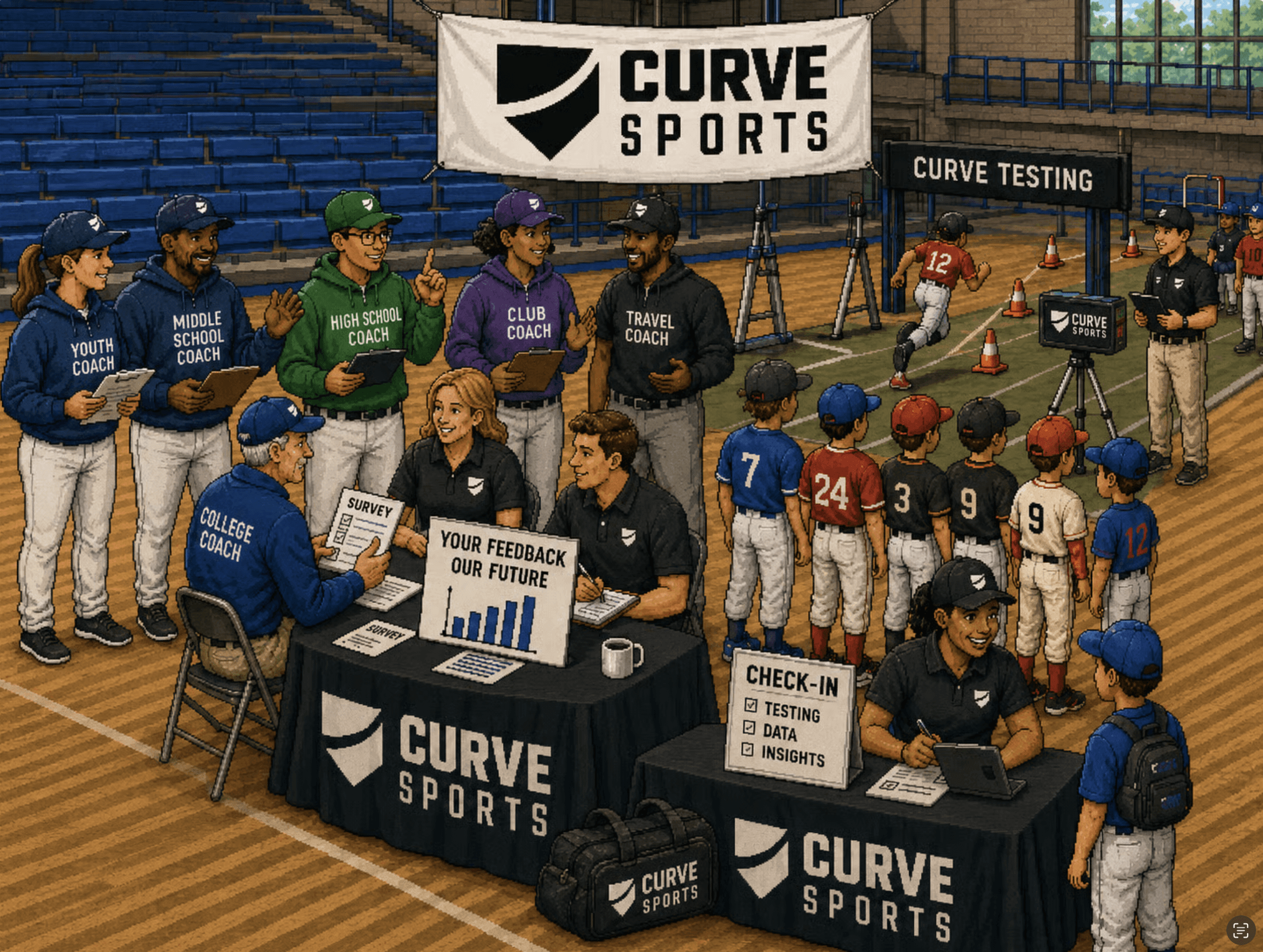
Curve Sports has tabbed the latter two groups to help craft its ambitious plans and protocols. The baseball development platform has partnered with assessment and certification firm Prometric to survey coaches nationwide in order to refine its Curve Testing program with a focus on fairness, standardization and validity.
Hundreds of coaches at club, middle school, high school, college levels will be asked to participate
Coach input will help establish importance, weighting of various test components, but will not be sole determining factor
Test components will be field-tested, statistically evaluated for consistency, relevance, validity
Three testing category scores — brain, body, ball — will inform composite, standardized athlete scores
Curve’s goal is to make standardized testing more accessible within the environments athletes already compete and train in while ensuing consistency and validity for coaches, families and recruiters. Prometric Chief Assessment Officer Nikki Eatschel said a frequent refrain of Curve CEO Sandy Ogg — that talent is equitably distributed, but opportunity is not — drives the process.
“You have a lot more opportunity when you've got something like this to get objective data available that you then can get in front of different colleges, different recruiters,” Eatschel said. “It all rests on having objective, valid data that coaches can trust, that recruiters can trust and that parents can trust.”
Curve aims for quarterly testing, head of testing Rachel Becker said. But it has found high school-aged athletes are interested in more frequent testing to track their progress more closely.
“You never really know if you're improving unless you're tracking it and you're testing it,” said Becker, a former Oklahoma State softball player who now plays in AUSL. “Being able to see in the data what your strengths and weaknesses are, and being able to really tailor your training and development to improve metrics in those weaknesses, I think it’s huge on the development side and the coaching side.
“From the recruiting side — college coaches most of the time have no idea where these numbers they're getting are coming from or how they're collected. And so for us, having standardized testing protocols, proctor training and all of these things which allow our data to be valid when it comes out, it’s huge for college coaches to be able to look at a curve test report and say, ‘OK, I know that this is accurate. And I am willing to go out and watch this kid play because I know this data is true.’”
There are currently four clubs/facilities with permanent testingcapabilities — Power Baseball in Florida, Pitch2Pitch in Minnesota, Illinois’ ITB and Knights Knation in Louisiana. Curve also has a mobile test center and team for one-off events.
The platform uses tech from Proteus Motion, Senaptec, Trackman and Universal Speed Rating. Becker said a full team can be tested in about an hour; it’s about 2-3 hours for a few dozen athletes and Curve can test about 300 over a 2-3 day period.
Curve plans for all clubs to eventually have access to local testingfacilities or the event-based model.

